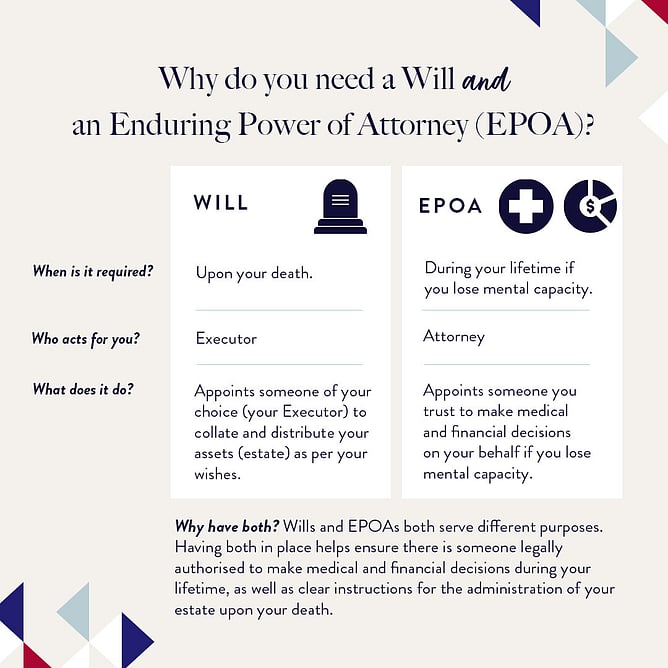
Wills and Enduring Powers of Attorney (EPOAs) are both important parts of planning for the future. While they are often prepared at the same time, they serve very different purposes.
What does a Will do?
A Will records your wishes for what happens to your estate (your assets) after your death.
In your Will, you appoint an executor – the person or people responsible for administering your estate. This includes gathering your assets, paying any outstanding debts and expenses, and distributing what remains to the people named in your Will.
Your Will can also set out:
who you want to inherit your assets;
specific gifts of money or personal belongings;
who you would like to appoint as guardians for your children; and
your wishes regarding burial or cremation.
Importantly, your Will only takes effect when you die.
If you die without a Will, you do not get to decide who administers your estate or who receives your assets. Instead, the law determines who is entitled to your estate. This may not result in what you would have wanted.
What is an Enduring Power of Attorney (EPOA)?
An EPOA operates during your lifetime and allows you to appoint someone you trust, called your attorney, to make decisions on your behalf.
In New Zealand, there are two types:
Property EPOA – covers your money, property and financial affairs. You can choose whether your attorney can act while you still have mental capacity or only if you lose capacity.
Personal Care and Welfare EPOA – covers decisions about your personal care and welfare, such as where you live and aspects of your healthcare. Your attorney can only act if you have been assessed as mentally incapable.
Generally, a medical practitioner will assess whether you have the mental capacity to make the relevant decision yourself. If you are assessed as mentally incapable, your attorney you have appointed, can then begin making those decisions on your behalf.
Isn't my spouse or family automatically able to act for me?
No. Being someone's spouse, partner, child or next of kin does not automatically give you legal authority to manage their property or make decisions for them if they lose mental capacity.
If you lose capacity without EPOAs in place, your family may need to apply to the Family Court for orders allowing someone to manage your affairs or make decisions for you. This can take time, involve significant cost and means you no longer have the opportunity to choose who will act for you.
Putting EPOAs in place while you have capacity means you choose who you trust to make those decisions.
Why should you have both?
Think of it as a timeline:
During your lifetime: your EPOAs allow your chosen attorney or attorneys to act for you when required.
After your death: your EPOAs come to an end and your Will takes over. Your executor then becomes responsible for administering your estate.
A Will does not help someone manage your affairs during your lifetime, and an EPOA does not determine what happens to your assets after you die. Having both means you have a plan in place for both situations.
When should you review them?
It is a good idea to review your Will and EPOAs when your circumstances change – for example, following a marriage or separation, the birth of children or grandchildren, a significant change in your assets, or the death or incapacity of someone you have appointed.
Even if nothing significant has changed, it is worthwhile checking from time to time that your documents still reflect your wishes.
Planning ahead
None of us can predict when these documents might be needed. Putting a Will and EPOAs in place while you are able to make your own decisions means you choose who will act for you and what you want to happen.
If you do not currently have a Will or EPOAs, or your existing documents have not been reviewed for some time, our team can talk you through your options and help make sure they continue to reflect your circumstances and wishes.